Recently, a friend of mine reposted one of those Facebook/email stories stories about violin virtuoso Joshua Bell busking in the New York subway and how all but two people and a few small children ignored him. It was paraphrasing an article called 'Pearls Before Breakfast', a 'social experiment' engineered by Gene Weingarten and the Washington Post in 2007. Weingarten won a Pulitzer Prize for it. Interestingly, his second Pulitzer was for a (very insightful and moving) article about the deaths of children left in their cars by forgetful parents - I suggest you read them both, not just for the quality of the writing, but also to understand the common point he is highlighting.
Most people I've heard react to the Bell story with 'oh yes, isn't it terrible how we just rush through life and don't enjoy the beauty, we must stop and smell the roses more often, it's so sad, we've become such automatons and slaves to the modern industrial world' - Weingarten compares the video of Bell's busking performance to that of Koyaanisqatsi ('Life out of balance'), an 80s film illustrating our descent into robotic antdoom, becoming cogs in the great wheel of progress and industry, the loss of beauty, art, music, self in the layers of urban consumerism.
Weingarten, Bell, the Washington Post and the makers of Koyaanisqatsi make a good point. There should be space for art, music, beauty, peace in everyone's life. But I resent the implication that because I work 9-5 as part of The Great Corporate Machine, I am ignoring the opportunities for beauty in my life.
For the record, Weingarten's article is not judgemental. He presents the facts and statements from the people interviewed and allows us to draw our own conclusions - as a journalist should. What I resent is the way his objective view has been regurgitated into chain emails and Facebook posts, with the obligatory 'oh it's too sad', inviting similar comments lest you be one of the unenlightened, the spiritually void, the Tin Man without a heart.
I work 9-5.30, five days a week. I travel 75 minutes each way to reach my office so I can live in a three bedroom house with a garden instead of a studio apartment. My office is in a modern high rise building made of glass and steel and I have a desk in a cluster of six other desks in a giant room that I share with 150 people, computers, phones, printers and photocopiers. My firm provides financial services and I am the sole 'creative' on staff, providing branding, formatting, application support and layout design for pitch documents, presentations, client reports and process flowcharts. I like my job, but it's not what I dreamed I'd do - I tried that for 15 years and got tired of being broke. Ten years ago I made a conscious decision to work 40 hours a week and get paid enough to be able to spend my evenings and weekends filling the parts of my life I don't spend at work with things that made me happy.
Now I give 48 hours a week of my life in exchange for more money than I've ever earned in my 23 years of working. And that money means that in the last 12 months, my partner and I were able to afford to go to the theatre a dozen times, visit art galleries, museums, travel to Australia for two weeks, spend a week driving around the island of Ibiza, eat out at nice restaurants and buy so many CDs and DVDs we had to buy more shelves to accomodate them. I also bought a camera. A good one, which meant I could finally start working on photography, a hobby I've been interested in since I was child.
Working for 'the man' also provides me with private health insurance, life insurance and a pension I'd never get if I'd stayed working in the arts.
 Yes, the commute gets frustrating. Yes, the workload can get tedious and open plan offices are noisy, distracting and tiring and yes, I could fit all the work I do in five days into three - but that's not how the system works. You're required to spend a portion of your 40 hours chatting to colleagues about fairly irrelevant topics, offering cups of tea if you're making one and showing an interest in other people's holidays and photos of their children - if you don't, you don't 'fit in'. Apparently 'fitting in' is key to getting the work done. And getting the work done is key to getting paid.
Once, a delivery made to my home had to be left on the front porch and I asked my boss if I could go home to ensure it wasn't stolen. It was 11am and my firm provides me with remote access to our systems, so I offered to work from home for the rest of the day, rather than waste three hours of my work day making the round trip. But my boss asked me to come back to the office as 'it looked better' for me to be present in the office. For a time, I worked at home two days a week when we were commuting from further away, but was relieved to give it up when we moved closer, as I was forever being asked 'Now, you're not in tomorrow are you?' and explaining that while I wasn't physically present in the office, I would be performing the same tasks and often working harder to justify that fact.
I have no illusions about how 'pointless' my job is in the greater scheme of the universe, but I work a lot less hours and make a lot more money than I ever did in the theatre. I also have a lot more time for myself.
Long distance commuting was one of the most stressful experiences I've ever had. And it wasn't about how much time I was spending travelling to and from home. It was about the physical and mental abuse of the public transport system. In a city like London, and I'm sure this applies to New York, Washington and any other city with a mass transport system and sprawling suburbs filled with people who work in the city centre, there are more people than the system can cope with. Trains are expensive, crowded, dirty, smelly and aging at an exponential rate.
We used to position ourselves on the platform where we knew the door would be on the incoming train and arrive 15 minutes early to grab that spot so we'd at least have a chance of getting a seat. It was that or end up standing in the aisles for 90 minutes of creaking, jerking, juddering into London, only to pile off and be shoved about by people made late for work by signal failures, overheating rails in summer, frozen points in winter, or my all time favourite - llamas that had escaped from a farm and were wandering over the tracks.
The result of this is that more often than not, I was rushing through the station, either late for work, or, worse, late for the train home, meaning I could be standing on the platform for another half hour until the next one. And I was one of a couple of million people in exactly the same situation, sardining ourselves into overcrowded train carriages, weaving through platforms fill with people, jostling for a place in the queue for the escalator, hoping we didn't end up pressed up against someone with body odour, bad breath or the tinny screeching of pop divas through plastic earphones. This is not an environment for appreciating art, music or culture.
A few year ago I heard about an organisation called 'Slow Down London' whose mission statement is 'to inspire Londoners to challenge the cult of speed and appreciate the world around us.' They went to the papers with a campaign stating they would be walking the streets of London during rush hour, stopping people and encouraging them to slow down. I am here to tell you that if one of those people had stopped me rushing on my way to catch my train home, which, had I missed, would mean 30 minutes less of my evening at home, I would have punched them in the face. I challenge any of them to match my record of cultural experiences over the past 12 months - all done because I can afford to do so - because I work a 40 hour week in The Machine.
So I say, not so much to Gene Weingarten and the Washington Post, who performed the experiment in what I hope is an unbiased piece of reporting, but to everyone who has ever forwarded that email, reposted that Facebook article or commented with a 'oh I know it's so sad' - you try commuting through a metro system with a million other people on a daily basis and see how keen you are to stop and listen to a guy playing the violin. Experiencing beauty like Joshua Bell playing the violin is one of life's imperatives. But you cannot tell me that experiencing that beauty when I have time, space and energy to actually enjoy it is not just as important.


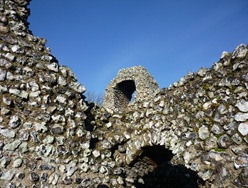 One of the coolest things about living in the UK is just how mind-bogglingly old everything is. In Australia, unless you're looking at Aboriginal art and landscape formations (which are also cool but not as accessible to the city-girl), everything ‘old’ within sensible driving distance of a pub or coffee shop is only just over 200 years old - like The Rocks in Sydney. All the cobble-stoned olde worlde goodness you can handle, but only two streets really, dating back to when the first English chaps decided to set up house when they got off the boats in 1788.
 But the cool, if slightly surreal, thing about them is that you'll be driving along and suddenly, out of the corner of your eye, you'll spot a pile of stones, a shadowy dip in the landscape, a structure that looks out of place in the suburban skyline. It will be sitting there, quietly, as it has for a thousand years, with livestock, tourists and local teenagers wandering past and through it, mostly oblivious to any historical significance (this is particularly true of livestock), it's just part of their neighbourhood. But in a lot of cases, an unassuming pile of rocks, a stone wall or a ramshackle structure will be older than anything around it (the earth not withstanding). Point in case,
 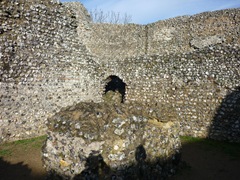 (an Irish chap named Sean) said (or would have said, had we not turned the sound off) 'You have reached your destination', five times before I finally spotted the English Heritage sign post saying 'Eynsford Castle'. I'd been joking to my chap that it was probably in the middle of someone's backyard... well... five minutes later we were negotiating a winding lane, in between the back fences of several semi-detached homes (and some very sweet slanty cottages) to what looked like someone's back driveway, to park alongside what were evidently local residents' cars (including a trailer) and lo, there was indeed the ruins of Eynsford Castle.
  The ruins are surrounded by what was a moat at some point (if I had a castle I'd so want a moat) and English Heritage have built a sturdy wooden bridge over the hollow that was the moat, leading into the main body of the castle, which is built on a raised section of ground. Now basically a pile of stone half- walls, it's more like a fort built by over-enthusiastic boy scouts who were called in for their tea before they could finish it. There is very much a feeling that it was a defined structure at some point, the information boards list out a kitchen, a great hall, a solar (lords and ladies chamber or bedroom) and undercrofts for both, with a spiral staircase that lead up to the first floor. Apparently there was some kind of Saxon structure built there before the castle was built in the late 11th century and many changes of hands and conflict surrounding the building throughout its life - at one point it was even a kennel and stable.
 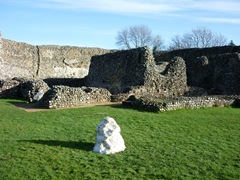 It was a gloriously sunny day, but it was still very cold (witness the remains of a snowman still frozen in the centre of the main section of the castle), not to mention the arrival of a family whose children didn't seem to grasp the concept of keeping their voices below a shout in public, so we did the rounds of the ruins, me