I've been a fangirl for more than two thirds of my life. It started in 1985, when I first heard about a Norwegian pop group called a-ha, who I still follow today (and have tickets for their last-ever *sniff* UK concert in November this year). I bought all their album s in the 80s (replaced them on CD in the 90s, put them on my iPod in the 00s), read all the magazine articles and bought the merchandise. In my 20s, I collected X-Files episodes, memorabilia and spinoff scientific books on the myths behind them. In a fortunate choice of jobs, I successfully
 stalked made contact with an actor whose work (and face) I had admired for years and inadvertently got myself invited to dinner at the family home. In my 30s, I followed a British pop band around the country (and even to Amsterdam), then nearly bankrupted myself following a related band after they broke up – this however, resulted in meeting my partner of five years (the drummer's best mate), so there was an upside to financial ruin.
I've hung out on forums and in chat rooms talking about songs, guitars, jeans and haircuts, I've made new friends at gigs (friendships that lasted longer than the bands themselves) and read (and written) all manner of good (but mostly bad) fan fiction, even before the internet existed. I've collected entire series of TV shows and books, I've written reviews (some of which resulted in the band seeking me out to say hi) and taken hundreds of (mostly blurry) photos. I've admired and sighed and swooned, I've cheered and danced and waved my hands in the air, I've gone back to gigs, movies and performances more than once, then tracked down rare footage (well before YouTube) to view at leisure in my home. I thought I had a pretty good understanding of the fan thing. Turns out I was doing it all wrong.
One of the things I was got wrong was that I never  really wanted to MEET the object of my admiration. The few times I did meet them, reality was inevitably grounding and sometimes disappointing. How do you live up to a performance in real life? You can't. I think in the back of my mind I knew that, but for the most part, I didn't want their only impression of me to be labeled, with a gigantic neon sign above my head, as a FAN.
As a FAN, I knew the Famous Person in question would be on their guard. Fans collect information, they collect it and share it, some to gloat over their ability to acquire it, others just to share and enjoy it with others they know would appreciate it. People in the public eye are aware of this and adjust their conversation appropriately. I wanted to have the kind of conversation I'd have if I was meeting someone through friends, or work, go to dinner, coffee or a pint and have a chat, not the one-sided kind where that someone was worried I was secretly taping the entire thing.
My other apparent mistake is that I don't approach fandom in the same way as a lot of the 'serious' fans out there, who don’t collect information or art, but experiences: conversations, photos with, signed objects, touched objects, waiting at stage door, attending multiple book signings, not to tell the actor/musician/author how much they enjoyed their work and have a conversation about process or other work, but just to say hi, shake hands and tally up another meeting. It's not to enjoy the object or the experience itself, for what it is, but to log another point in the grand scale of fandom.
I came to this realisation very recently – last weekend in fact. I went to my very first book signing. I've never gone to one because I figured while it's nice to have a book with the author's signature on it, I always wondered what the point of it was. The author isn’t my friend and speaking to him for 20 seconds that he isn’t going to remember in the thousands of 20 second meetings he'd have in his lifetime isn’t going to overly enrich either of our lives.
Fandom, I'd always thought, is about trying to make a connection. You see a film, a play, hear a song, read a book, you're impressed, moved, something about the work touches you. The person who created it is obviously someone you admire for their talent and creativity – and we always want to make a connection with someone we admire. In this age of interconnectivity, of Web 2.0, suddenly this becomes more possible. We follow a Famous Person on Twitter, and if we're lucky and clever enough, they'll see a tweet we send to them and reply to it. Receiving a response from someone you admire is heartening and I always harbour a microscopic (and therefore futile) hope that this could, might, just may be the start of an ongoing conversation… but it rarely is. Particularly if, like me, you back off immediately, in terror of being labeled as a FAN.
The book signing was for Joe Hill's new book Horns, and as I've outlined in a previous post, I had a fairly triumphant experience discovering this particular author.
So I went to the signing, queued up for an hour, had my book signed and chatted about jet lag – my 20 seconds with Joe Hill. All fine. But the odd part of the day was the other fans.
 I already had my copy of Horns and had considered taking my copy of Heart-Shaped Box, but thought that was a bit presumptuous, as the signing was specifically for Horns. I shouldn't have worried. Some of the other people there had brought two, four, eight and ten copies EACH of the book to be signed. And sign he did, nice chap, knowing full well that these books were going straight onto eBay and he wouldn't see a penny of the mark up his signature would give them. He posed happily for photos and made jokes with everyone, some of whom had been to a few, if not all, of the signings he'd done throughout the UK that week, despite being weekdays and all times of the day.
Now I get the following-around thing. I've taken days off work to travel to the other end of the country to see a band play and meet with friends who are also fans. But that was an entire evening, sometimes a weekend including sight-seeing, four or five hours of music and dancing and drinking… not two minutes of small talk and watching someone sign a book.
A lot of the fans knew each other, obviously from attending signings, and were comparing notes about the next one they were going to (for another author) and past signings with other authors. One woman was joking about how she'd had to curb her book signings because her 'social life' was starting to encroach on the time she was spending with her children. But the most extraordinary thing were the lists. Lists of who'd been to what signing and how many books they'd managed to get signed, whether the author was happy to sign multiple copies and have their photo taken. These signings, it seems, were not a chance to connect with the person who'd enriched your life with their creativity, they were notches on the great bookmark of fandom. Your status as a fan increased with the number and variety of signatures you'd managed to acquire.
I’ve done some obsessive-compulsive things in my fan career, I own some rubbish merchandise and have spent way too much money on things non-fandom folks would see as irrelevant. But if this acquisition of two minute meet-and-greets is what it take to be considered a 'fan' in the age of the internet, I feel that my aversion to meeting the Famous Person, my contentment with a one-sided 'relationship' and my desire only to connect with them to tell them how much I enjoyed their work appears to make me a failure. But I do wonder if my experience of fandom isn’t richer as a result.


 someone round to a) get the agreement signed and witnessed in person and b) do an inspection of the flat to make sure we hadn't sold off the appliances, repainted the walls black or ripped up the carpet. Fair enough, if I was a landlord I'd want to check that too, even if the tenants paid the rent on time, didn't complain (much) or cause any complaints to be made. Like us.
  One of the coolest things about living in the UK is just how mind-bogglingly old everything is. In Australia, unless you're looking at Aboriginal art and landscape formations (which are also cool but not as accessible to the city-girl), everything ‘old’ within sensible driving distance of a pub or coffee shop is only just over 200 years old - like The Rocks in Sydney. All the cobble-stoned olde worlde goodness you can handle, but only two streets really, dating back to when the first English chaps decided to set up house when they got off the boats in 1788.
 But the cool, if slightly surreal, thing about them is that you'll be driving along and suddenly, out of the corner of your eye, you'll spot a pile of stones, a shadowy dip in the landscape, a structure that looks out of place in the suburban skyline. It will be sitting there, quietly, as it has for a thousand years, with livestock, tourists and local teenagers wandering past and through it, mostly oblivious to any historical significance (this is particularly true of livestock), it's just part of their neighbourhood. But in a lot of cases, an unassuming pile of rocks, a stone wall or a ramshackle structure will be older than anything around it (the earth not withstanding). Point in case,
  (an Irish chap named Sean) said (or would have said, had we not turned the sound off) 'You have reached your destination', five times before I finally spotted the English Heritage sign post saying 'Eynsford Castle'. I'd been joking to my chap that it was probably in the middle of someone's backyard... well... five minutes later we were negotiating a winding lane, in between the back fences of several semi-detached homes (and some very sweet slanty cottages) to what looked like someone's back driveway, to park alongside what were evidently local residents' cars (including a trailer) and lo, there was indeed the ruins of Eynsford Castle.
  The ruins are surrounded by what was a moat at some point (if I had a castle I'd so want a moat) and English Heritage have built a sturdy wooden bridge over the hollow that was the moat, leading into the main body of the castle, which is built on a raised section of ground. Now basically a pile of stone half- walls, it's more like a fort built by over-enthusiastic boy scouts who were called in for their tea before they could finish it. There is very much a feeling that it was a defined structure at some point, the information boards list out a kitchen, a great hall, a solar (lords and ladies chamber or bedroom) and undercrofts for both, with a spiral staircase that lead up to the first floor. Apparently there was some kind of Saxon structure built there before the castle was built in the late 11th century and many changes of hands and conflict surrounding the building throughout its life - at one point it was even a kennel and stable.
  It was a gloriously sunny day, but it was still very cold (witness the remains of a snowman still frozen in the centre of the main section of the castle), not to mention the arrival of a family whose children didn't seem to grasp the concept of keeping their voices below a shout in public, so we did the rounds of the ruins, me
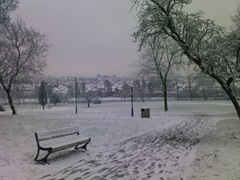 However, I'm not convinced about snow. The first time I saw snow (actual snow falling from the sky, as opposed to sitting in frozen lumps on the side of a mountain) I was in New York on holiday. I was travelling on my own (though I was staying with my brother in Brooklyn, he had to work all week) and I had just finished looking at treasures in the Pierpont Morgan Library and Museum on Madison Avenue. I was collecting my coat from the cloakroom at the front entrance and looked out through the glass door to see tiny white fluffy things floating around in the air. It took me a minute to realise what it was, and I think I must have been standing there looking amazed because the large black security guard at the door stepped forward and asked me if I was okay. I said I was, I'd just never seen snow before. He was amused in the way that I'd only ever seen New York characters on television amused - he laughed out loud and announced to the couple who were leaving the museum behind me that I'd never seen snow! They smiled in that kindly patronising way that New Yorkers do and stepped past me, putting up their umbrellas as they left.
  first snow - I walked back up to Central Park, gazing around at the snowflakes with an expression not unlike Jeff Bridges' in Starman and trying to catch them on my hand and my tongue. That night it snowed enough to make the pavements slippery and give mailboxes and railings snow cone hats (though CNN would have you believe that a blizzard was on its way). I ventured forth into freezing sleet (this time with my umbrella, can't tell you what a difference it made), thanking my sensible hiking books and diligent shop keepers with grit bins for stopping the worst of the pavement slipping and then realised why snow in an urban environment is not necessarily a wondrous thing. Once the city heats up the snow enough to ice over, everything is slippery. If the snow stays as snow it's fine, you can plough through drifts in waterproof boots and the soles will grip as they should and so long as you don't try and rush, you'll get where you're going without falling over. When it's icy, chances of arriving at your destination without a soggy bum are slim to none.
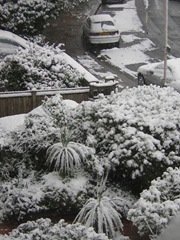
  So here is my quandary. I love to watch the snow. I love to see the white feathers swirling, floating, piling up on tree branches. I love the way it sits on top of post boxes and window sills, the icing sugar on sponge cake look of roofs and lone trails of footprints (human and canine) through pristine parkland. I like seeing kids (and grownups) making rude snowmen and chucking lumps of it at each other, I like the way that dogs are ridiculously excited by it and zoom around, nose to the ice, trying to figure it out, as if they've never seen it before. It's still a marvellous magical phenomenon to me, and I get completely snap-happy.
  actually falling down. I hate having to leave extra time to get to the station in the morning, I hate having to remember spare socks and hoping that my boots will hold up to their waterproof bargain and my toes won't be wrinkled and cold when I get to the office. I hate the messy slippery slush left behind after several thousand pedestrians have traipsed through the snow on their way to work, much earlier than me. I hate the way the UK's transport system breaks down when more than an inch of powder lands on the train tracks, roads and airports. Just before Christmas there was an unexpected snowfall about 4 o'clock in the afternoon, a good two inches landed on London with a 'whoomp' and all vehicular transport ceased to function.
  Trains were delayed, cancelled, gave up and went back to their train duvets in their train sheds. Traffic banked up as cars slipped and skidded on roads (hills were impossible) unless they'd managed to get in behind the frantically-deployed army of grit lorries. Buses stopped in case they slid on the road or crashed into shop fronts at three miles per hour, killing everyone on board and spoiling Christmas displays. We got to our next-to-local train station, waited for a bus in the snow only to be told they'd all stopped, then gave up and walked home. It's normally a 30 minute stroll over a grassy heath and along not-unpleasant shop-lined streets, but it took us nearly an hour plodding along in our hiking boots (I exceeded the limits of their waterproofness at about 40 minutes). I held onto my chap's arm with a vice-like grip, paranoid about ice patches and spent the entire walk with my eyes on the ground, placing my feet in a steady, stomping fashion like so many snow-shoed Eskimos before me.
  Of course later, in my contrary way, I was taking photos from the window of our flat, watching in wonder at the swirling flurries and wondering how long the road surface would stay coated in the snowy frosting before a car (or a grit lorry) came along to destroy the illusion.
  playing Nancy (the coverage of these shows means it's impossible to completely ignore them) and I was pretty sure she'd won a competition to play the role. However, when we got there, the 'alternate' Nancy was on for the evening, Australian actress, Tamsin Carroll. Tamsin was exceptional, as I would expect from a young woman who has been working in the theatre since childhood. But it got me thinking. Why was there an 'alternate'? Not an understudy (the role of Nancy has two understudies), but someone who plays the role for a specific number of performances each week.
 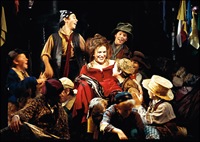 Most West End shows run eight shows a week (six nights and two matinees) and often additional rehearsals during the week for understudies and swings (performers covering multiple supporting roles). That's two hours a show onstage and for a production like Oliver!, leading actors usually have some vocally strenuous numbers. So logic would dictate that you're going to need some strong singers. Singers with training, technique, experience. Singers who can handle eight shows a week, two hours a night and not lose their voice by Saturday night.
  average performance in Equus, Josh Harnett lacked the presence and gravitas of his theatre-trained co-star Adam Godley in Rainman (but Harnett was aware of it, and suitably humble in his curtain call) and Kelly Brook has been hired for her 'talents' to play an 'ordinary woman' in Calendar Girls. Not to say 'famous' equals 'no talent', I saw the superb (theatre-trained) Gillian Anderson in What The Night is For, Brendan Fraser and Frances O'Connor were just perfect in Cat On A Hot Tin Roof (and I'm eagerly awaiting James Earl Jones and Adrian Lester in the latest production of same), John Barrowman was wowing theatre crowds long before he was Captain Jack Harkness and I can die happy knowing I saw Ian McKellen and Patrick Stewart in Waiting for Godot. But these are all performers who put in the ground work from day one, who earned their dues and got the break they worked for. They have talent which made them famous, as opposed to mass-market personality appeal which made them famous.
  I was in Prêt a Manger today, which I am most days, as I buy my morning latté from them. Prêt make the best lattés of all the chain stores in London. I'll go to Starbucks at a pinch (and load it up with vanilla or caramel), Costa as a last resort and Cafe Nero ONLY if the baristas are Mediterranean. English Cafe Nero baristas evidently all drink Nescafé at 40 degrees Celsius and wouldn't know a good latte if it imploded in front of them. The best coffee I’ve found in London (so far) is made by the lovely ladies at